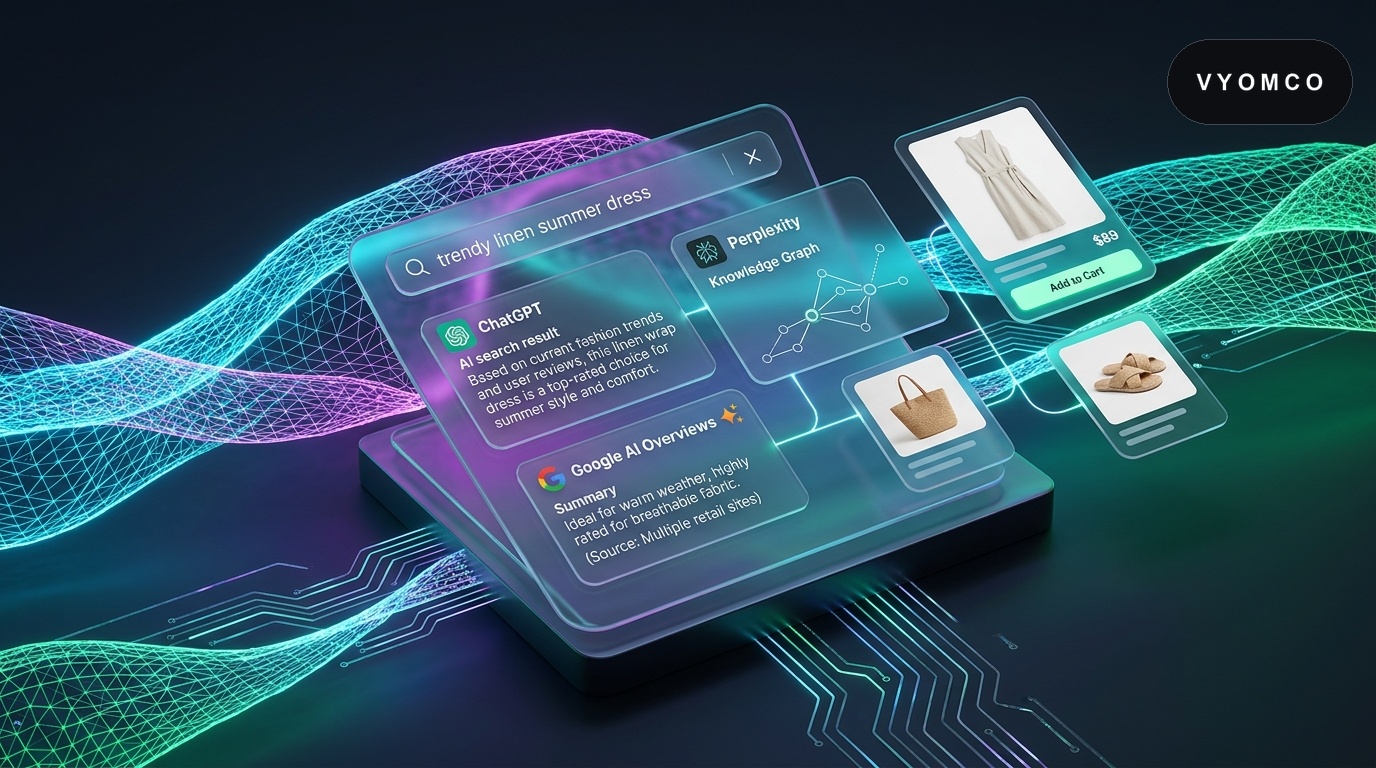
What is Generative Engine Optimisation (GEO)?
Generative Engine Optimisation (GEO) is the practice of structuring, enriching, and distributing your brand and product data so Large Language Models (LLMs) like OpenAI ChatGPT, Google Gemini / AI Overviews, Perplexity AI, and Claude cite, recommend, and display your Shopify products when users query conversational search engines.
In traditional search engine optimization (SEO), the goal was earning top rank positions on Google's search engine results pages (SERPs) by matching keyword queries and acquiring backlinks. In GEO, the objective shifts from winning clicks on a list of blue links to becoming the synthesis source — the authoritative brand chosen by an AI model when it answers complex, conversational buyer prompts such as:
"Find me an eco-friendly minimalist linen blazer for men under £180 with breathable lining and free international returns that ships to the UK."
When a prospective customer asks a query like this, the LLM does not scroll through ten web links; it retrieves real-time semantic entities, verifies product attributes, assesses brand sentiment, checks pricing, and delivers a concise comparison featuring 2–3 recommended products. If your Shopify store has not been engineered for GEO, your catalogue is invisible to this massive wave of high-intent buyers.
How AI Search Engines Evaluate & Recommend Products
Generative engines rely on a combination of Retrieval-Augmented Generation (RAG), vector similarity databases, and structured knowledge graphs to evaluate products in real-time. Understanding this 4-layer evaluation framework is essential for any modern Shopify merchant:
- 1. Direct Indexing & Semantic Embeddings: AI engines convert your page content, product specifications, material properties, and use cases into multi-dimensional vectors. When a user describes their problem or aesthetic preference, the engine matches the semantic intent rather than exact keyword strings.
- 2. Real-Time Retrieval (RAG): Tools like Perplexity, ChatGPT Search, and Google AI Overviews query live web crawlers (such as
OAI-SearchBot,PerplexityBot, andGoogle-Extended) to fetch current inventory status, pricing, shipping tiers, and discount codes. - 3. Entity Authority & Consensus Verification: LLMs verify factual claims by cross-referencing multiple third-party sources (Reddit discussions, editorial reviews, industry roundups, Trustpilot, and YouTube transcripts). Brands with high consensus across independent domains receive disproportionate recommendation weighting.
- 4. Structural Machine-Readability: Clean JSON-LD schema, standardized HTML headings, concise comparison tables, and explicit FAQ schema allow AI parsers to extract pricing, dimensions, warranties, and care instructions without hallucination risk.
Traditional SEO vs. Generative Engine Optimisation (GEO)
GEO does not replace SEO — it builds directly on top of technical fundamentals while fundamentally shifting content composition and distribution:
| Evaluation Metric | Traditional SEO | Generative Engine Optimisation (GEO) |
|---|---|---|
| Primary Goal | Rank on Page 1 / Position 1-3 for keywords | Become the cited, synthesized answer & recommended product |
| User Intent | Short-tail / keyword queries (e.g. "men linen shirts") | Multi-clause conversational prompts with constraints & preferences |
| Algorithm Core | PageRank, keyword density, anchor text backlinks | Vector embeddings, entity knowledge graphs, cross-source consensus |
| Content Focus | Keyword insertion, blog length, meta tags | Dense information gain, structured tables, fact density, clear attributes |
| Conversion Path | Search → SERP Click → Landing Page → Browse | AI Recommendation → Direct PDP Link / Autonomous AI Checkout |
The Shopify Schema & Entity Graph Blueprint for GEO
AI search bots prioritize machine-readable structured data. If your Shopify theme relies on default, thin schema markup, language models must guess your product properties. To achieve maximum AI visibility, your Shopify theme must output rich, nested JSON-LD schema:
1. Granular Product Entity Schema: Go beyond basic name and price. Include material, color, pattern, size, gtin13/mpn, weight, aggregateRating, hasMerchantReturnPolicy, and shippingDetails.
2. ItemAvailability & Live Stock Feeds: Ensure offers.availability dynamically reflects https://schema.org/InStock with correct currency symbols across all active Shopify Markets.
3. Organization & SameAs Social Graph: Map your brand identity with sameAs links connecting your Shopify store to your Wikipedia page, Crunchbase profile, verified social channels, Trustpilot profile, and patent filings.
4. HowTo and ItemList Schemas: Use structured data on collection pages and buying guides to define clear product hierarchies and step-by-step sizing/selection procedures.
How to Optimise Shopify Product Detail Pages (PDPs) for LLMs
Standard marketing fluff ("crafted with passion for the modern trendsetter") is completely ignored by AI models. LLMs extract and synthesize hard facts. To win AI recommendations, restructure your Shopify product copy around Information Gain and Attribute Density:
- Use Concrete Technical Specifications: Detail exact GSM fabric weights, battery milliamp hours, certifiable sustainability credentials (e.g. GOTS-certified organic cotton), and precise dimensions.
- Include Explicit Use-Case Scenarios: Dedicate a section to "Best For" and "When Not to Use". AI engines frequently filter products by situation (e.g. "best winter boots for sub-zero temperatures vs light rain").
- Implement Comparison Tables on PDPs: Add a structured comparison table showing how this product compares to adjacent models in your catalogue. LLMs parse tables significantly faster and with higher fidelity than paragraphs.
- Answer Unspoken Friction Points in Native FAQs: Embed accordion FAQs answering shipping speeds, care instructions, compatibility, and sizing tolerances. This provides direct quote snippets for AI answer engines.
Building Off-Page LLM Citations & Third-Party Consensus
A fundamental law of Generative Engine Optimisation: An AI model will rarely recommend a product solely based on what the brand says about itself. It seeks independent third-party consensus.
To build unbreakable AI authority for your Shopify store:
- Dominate Reddit and Community Discussions: Reddit is heavily weighted in Google AI Overviews and ChatGPT Search training datasets. Authentic community advocacy, AMAs, and high-karma user recommendations in niche subreddits directly feed AI citation algorithms.
- Target High-Domain Editorial Inclusions: Being cited in "Best of" roundups on reputable publication sites provides the co-occurrence signals AI models use to build association graphs between your brand and category keywords.
- Cultivate Structured Customer Reviews: Reviews containing detailed user feedback (e.g. "true to size", "durable after 50 washes") provide sentiment data that AI models query to validate product claims.
Preparing Your Shopify Store for Agentic AI Commerce
The next phase beyond AI search is Agentic Commerce — where autonomous AI assistants will not only find products on behalf of consumers, but also execute the purchase transaction directly. Read our deep-dive on AI Ecommerce Development for technical architectural considerations.
To be ready for AI shopping agents:
- Adopt Headless or Fast Liquid Architecture: Ensure your storefront API responds in sub-200ms. AI agents drop slow, unresponsive store endpoints.
- Implement Shopify Checkout Extensibility: Ensure one-click payment protocols (Shop Pay, Apple Pay, digital wallets) are seamlessly connected without legacy liquid script bottlenecks.
- Expose Clean LLMs.txt & Feed Endpoints: Provide a public machine-readable catalogue summary (like an
llms.txtfile) summarizing product inventory, categories, pricing, and brand policies.
90-Day GEO Execution Framework for Shopify Brands
Here is the step-by-step roadmap we deploy for Vyomco clients transitioning their stores to AI-first search dominance:
- Days 1–30: Technical AI Audit & Structured Data Overhaul. Implement nested JSON-LD schema across all products, collections, and brand entities. Unblock AI search crawler user-agents in
robots.txt. - Days 31–60: PDP Copy Restructuring & Fact Density. Rewrite top 20 revenue-generating PDPs to feature explicit attribute tables, use-case filters, sizing guides, and technical specifications.
- Days 61–90: Off-Page Entity Graph & Citation Campaign. Secure inclusion in top authoritative category comparison roundups, clean up external brand entity profiles (Wikidata, Crunchbase, Trustpilot), and launch community sentiment initiatives.
Vyomco's Strategic View on the Future of Commerce Search
The merchants who treat AI search as a fleeting trend will find their organic customer acquisition drying up just as brands that ignored mobile commerce did in 2012. GEO is not an optional marketing experiment; it is the new architecture of organic discovery.
By engineering your Shopify store with semantic entity clarity, high information gain, and multi-source consensus, your brand captures both traditional Google searchers today and the millions of high-spending buyers discovering products through AI engines tomorrow.
If you want a dedicated technical audit of your store's AI search visibility or custom Shopify Plus development, reach out to the Vyomco team today.