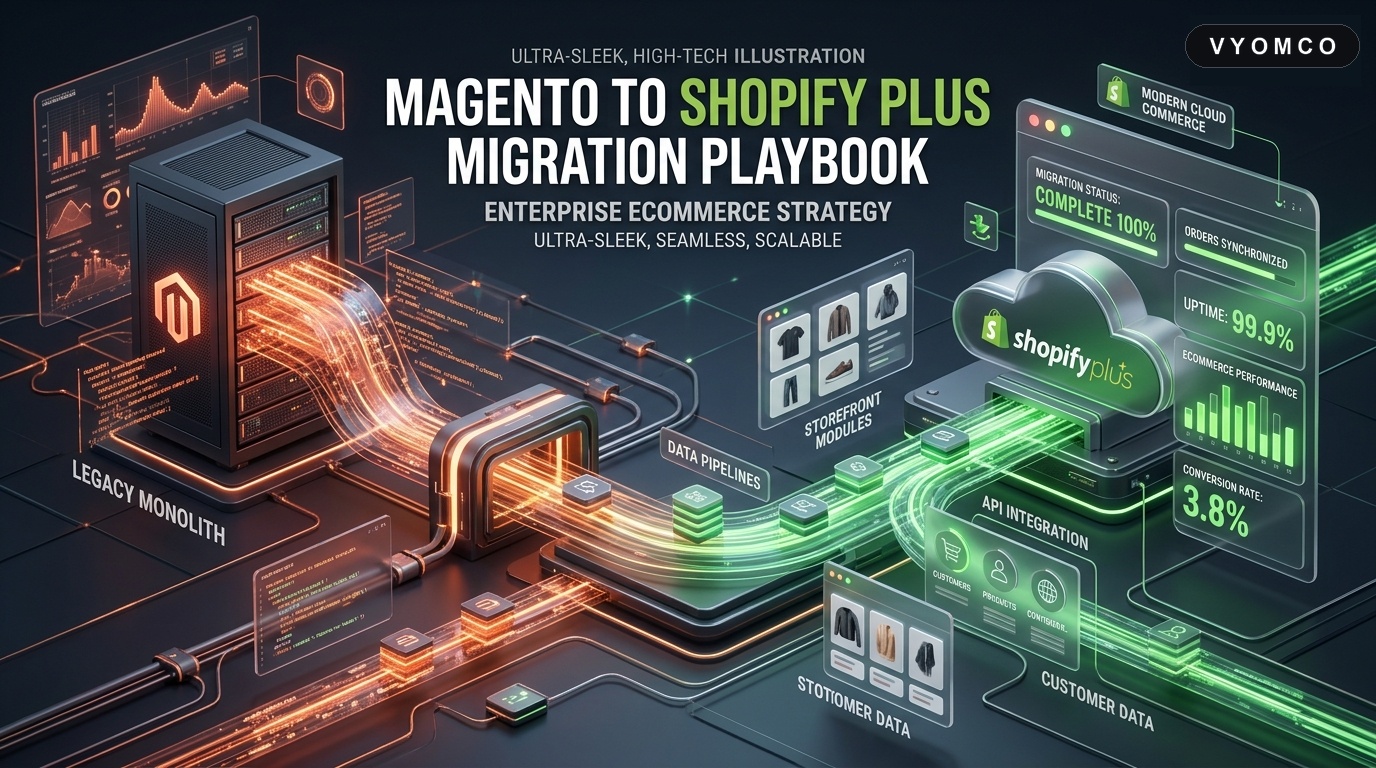
Why Enterprise Merchants Are Leaving Adobe Commerce for Shopify Plus
Over the last three years, the commercial calculation for running Adobe Commerce (Magento) has inverted. What once offered enterprise teams total customizability has become a multi-six-figure maintenance tax that slows product releases to a crawl.
Across the 50+ enterprise migrations we have directed at Vyomco, five catalysts repeatedly force CTOs and Heads of Ecommerce to initiate replatforming:
- Security Patching Exhaustion: Magento sites require continuous, mandatory security updates (APSB releases). Each patch risks breaking third-party extensions and custom checkout logic, consuming 20–40 hours of senior developer time each month simply keeping the storefront compliant.
- Massive DevOps & Infrastructure Overhead: Running dedicated high-availability clusters (AWS EC2, RDS, Redis, Varnish, Elasticsearch) easily costs $3,175 to $12,700+ monthly in raw hosting fees, plus round-the-clock sysadmin support. On Shopify Plus, hosting, 99.99% uptime, and flash-sale autoscaling are fully managed.
- Crippling Upgrade Costs: Version updates between minor Magento versions (e.g., from 2.4.4 to 2.4.7) regularly quote upwards of $50,800 – $101,600 because of broken backward compatibility with legacy plugins.
- Developer Scarcity and Retainer Inflation: Specialized Magento developers command high hourly rates, and code delivery is notoriously slow due to Magento's complex XML layout system and PHP DI (Dependency Injection) compilation cycles.
- Marketing & Merchandising Friction: Non-technical marketing teams on Magento cannot deploy new landing pages or A/B tests without filing engineering tickets. Shopify Plus Online Store 2.0 empowers marketers to customize storefronts in real time without touching backend code.
Total Cost of Ownership (TCO): Magento 2 vs. Shopify Plus
When enterprise CFOs model the financial impact of migrating to Shopify Plus, the total cost of ownership (TCO) reduction is immediate and substantial. Consider the realistic annual operating costs for a brand generating $12.7M to $31.8M in annual GMV:
| Cost Category | Adobe Commerce (Magento 2) | Shopify Plus |
|---|---|---|
| Platform / Software License | $44,450 – $107,950 / year (GMV-tiered) | From ~$27,432 / year ($2,000/mo flat floor) |
| Cloud Hosting & DevOps Support | $38,100 – $114,300 / year (AWS/Adobe Cloud) | $0 (Fully included with unlimited bandwidth) |
| Security Patching & Compliance | $31,750 – $63,500 / year in developer hours | $0 (Level 1 PCI DSS compliant automatically) |
| Maintenance & Bug Fixing | $76,200 – $152,400 / year agency retainers | $25,400 – $50,800 / year focused on growth/CRO |
| Major Version Upgrades | $50,800 – $101,600 every 18 months | $0 (Zero-downtime rolling feature releases) |
| Estimated Annual Operating Cost | $241,300 – $539,750+ | $69,850 – $139,700 |
In practice, brands reallocating these freed-up budgets directly into conversion optimization (CRO) and paid customer acquisition routinely see significant top-line revenue gains within 90 days of going live on Shopify Plus.
Data Migration Architecture: Moving from EAV to Shopify Metafields
Magento uses an Entity-Attribute-Value (EAV) database model that allows unlimited custom product attributes, but causes significant database query complexity. Shopify uses a streamlined, lightning-fast core schema complemented by Native Metafields & Metaobjects.
A successful data migration follows four strict pipelines:
- 1. Customer Records & Password Security: Shopify's secure architecture prevents raw password hashes from being imported directly. Vyomco deploys automated password-reset and account activation invitation workflows (via Klaviyo or custom APIs), offering returning customers a seamless one-click re-activation incentive.
- 2. Product Matrices & Complex Bundles: Magento configurable products map cleanly to Shopify variants (up to 2,000 variants per product on modern Shopify architecture). Complex EAV attributes (technical specs, ingredients, compatibility matrices) are mapped to Shopify Metafields, preserving rich filterability via Search & Discovery.
- 3. Historical Order & Financial Data: We migrate 3–5 years of historical order data for lifetime value (LTV) calculation, RMA tracking, and customer loyalty retention, archiving legacy orders through Shopify's Draft and Completed Order APIs without triggering false fulfillment notifications to buyers.
- 4. Customer Reviews, Wishlists & Loyalty Points: Review history and user-generated content are extracted from legacy Magento tables and imported into modern platforms like Yotpo, Judge.me, or Okendo with complete historical timestamps and verified purchase badges.
SEO Equity Preservation & 301 Redirect Strategy
The single greatest risk of replatforming is organic traffic loss caused by sloppy URL handling. Magento's URL structure (often ending in .html or deeply nested subcategories) differs entirely from Shopify's standard taxonomy (/collections/ and /products/).
At Vyomco, our SEO replatforming protocol guarantees zero organic traffic drops:
- Comprehensive Pre-Launch Crawl: We crawl 100% of your legacy Magento site using Screaming Frog and Google Search Console API exports, identifying all indexable URLs, canonicals, and backlinks.
- Algorithmic 1-to-1 Redirect Mapping: Every legacy Magento product, collection, blog post, and CMS page is mapped directly to its equivalent Shopify destination. Generic redirect chains or mass-redirects to the homepage are strictly banned.
- Structured Data & Schema Continuity: We ensure product schema, breadcrumbs, organization graphs, and review markup remain continuous across the cutover window so search engines retain rich snippet rankings.
- Post-Launch 404 Sentinel Monitoring: During the first 30 days post-cutover, automated log monitors capture and auto-redirect any unexpected legacy URL hits within minutes. Read our dedicated SEO Migration Guide for deeper methodology.
Connecting Your ERP, WMS & Order Management Systems
Enterprise Magento stores rarely operate in isolation. They connect to enterprise resource planning (ERP) platforms like SAP, Oracle NetSuite, Microsoft Dynamics 365, or Brightpearl.
Shopify Plus provides enterprise-grade integration capabilities:
- High-Throughput GraphQL APIs: Shopify Plus grants increased API rate limits (up to 40 requests/sec with bulk operations support), enabling real-time stock sync across multiple regional warehouses.
- Shopify Flow & Custom Webhook Architecture: Routine operational tasks (order tagging, fraud verification, VIP customer routing) run automatically via serverless event webhooks.
- iPaaS Middleware Integration: Whether connecting via Celigo, Boomi, Patchworks, or custom microservices built on AWS Lambda, data flows bidirectionally between Shopify and your logistics hub.
Replacing Magento B2B with Native Shopify Plus Wholesale
Many merchants stay on Magento because of wholesale needs. However, Adobe Commerce's B2B suite is notoriously fragile and difficult to customize.
Shopify Plus Native B2B replaces complex third-party Magento modules with native, battle-tested features directly in the core admin:
- Company Profiles & Locations: Assign multiple buyers to a single wholesale client with distinct role permissions and spending limits.
- Custom Price Lists & Volume Tiers: Assign negotiated price books, percentage discounts, and minimum order quantities (MOQs) by company.
- Flexible Payment Terms: Support Net 15/30/60 invoicing, purchase orders (PO numbers), vault credit cards, and automated draft orders.
- Blended DTC & B2B Storefront: Run retail and wholesale through a single unified storefront or split them across dedicated expansion stores included in your Plus plan.
The 9-Phase Enterprise Migration Framework
A typical enterprise migration spans 10 to 16 weeks depending on catalogue size and integration complexity:
- Phase 1: Discovery & Architecture Review. Audit Magento code, database schemas, extension dependencies, and third-party integrations.
- Phase 2: Data Modeling & Schema Design. Map Magento EAV attributes to Shopify Metafields, collections, and variant structures.
- Phase 3: Storefront UX/UI Design. Create custom Online Store 2.0 theme components or headless frontend architectures built for high conversion.
- Phase 4: Core Data Extraction & Staging Import. Migrate sample batches of products, customers, and order history to the staging environment.
- Phase 5: Middleware & ERP Pipeline Build. Build and test connectors for ERP, OMS, warehouse fulfillment, and CRM (Klaviyo).
- Phase 6: Technical SEO Crawl & 301 Matrix. Build the exhaustive 1-to-1 redirect map and configure automated canonical handling.
- Phase 7: End-to-End User Acceptance Testing (UAT). Test complex checkout scenarios, discount logic, B2B purchasing, and mobile UX.
- Phase 8: Delta Sync & Cutover. Freeze Magento order processing, perform final differential data migration, switch DNS records, and verify live checkouts.
- Phase 9: Post-Launch Hypercare (30 Days). Real-time error monitoring, 404 tracking, Core Web Vitals audit, and immediate conversion tuning.
3 Costly Replatforming Mistakes to Avoid
Learn from the mistakes common in unguided migrations:
1. Trying to replicate every legacy Magento extension 1-to-1. Merchants often have 40+ Magento plugins installed, of which half are redundant. Use replatforming as an opportunity to audit and streamline your tech stack.
2. Leaving SEO until the week of launch. 301 redirect mapping and structured data specifications must be planned from Day 1, not treated as an afterthought.
3. Neglecting Customer Activation Strategy. Without an engaging reactivation email campaign, returning customers will face login hurdles. Plan an enticing VIP perk or discount for customers verifying their new accounts.
Vyomco's Strategic Verdict
Migrating from Magento to Shopify Plus is not merely a change in hosting; it is an organizational unlock. By freeing your engineering team from server maintenance and constant patch cycles, you redirect your resources toward product innovation, customer acquisition, and brand expansion.
At Vyomco, our end-to-end engineering, SEO, and integration teams ensure that your migration is executed seamlessly without downtime or organic ranking losses. Schedule an enterprise migration consultation with our technical team today.